
End Suction Centrifugal Pump vs Vertical Inline Pump: Which Is Best for HVAC Circulation?
Release time: 2026-11-12
Table of Contents
Choosing between a horizontal end suction centrifugal pump and a vertical inline pump is rarely a question of which pump is universally “better.” The right choice depends on the HVAC loop’s flow and head requirements, available mechanical-room space, piping layout, maintenance access, noise constraints, and expected operating pattern.
For many commercial buildings, end suction HVAC pumps are the practical choice for chilled-water, condenser-water, and hot-water circulation systems that need stable hydraulic performance, accessible maintenance, and flexibility across a wide duty range.
What Each Pump Does
Both pump types are centrifugal pumps: they convert motor power into kinetic energy and then into pressure to move water through the HVAC system. The difference lies mainly in their mechanical arrangement, installation footprint, and service approach.
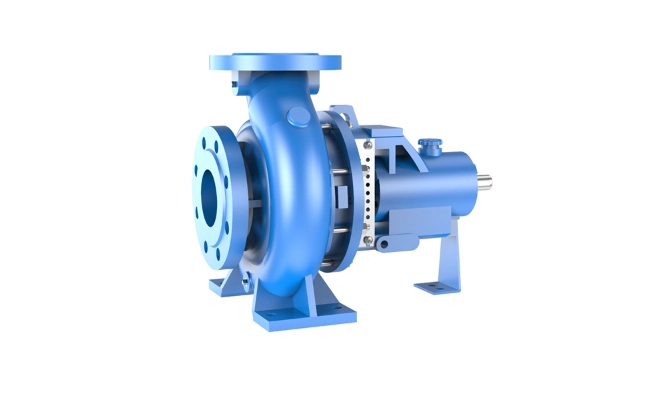
A horizontal end suction centrifugal pump has a horizontally mounted casing with an end suction inlet and a vertical discharge outlet. It is commonly base-mounted, which provides a stable foundation and convenient access to the coupling, seal, bearings, and impeller during maintenance.
A vertical inline pump is installed directly in the pipeline, with suction and discharge typically aligned on the same centerline. Its compact arrangement reduces the floor area required in a mechanical room, but it still needs adequate vertical clearance for motor removal and maintenance.
Key Differences
| Selection factor | Horizontal End Suction Centrifugal Pump | Vertical Inline Pump |
|---|---|---|
| Installation footprint | Requires a base, foundation or inertia base, and surrounding service space | Requires less floor area because it mounts in the pipe run |
| Piping arrangement | Suction and discharge are not on the same centerline; piping needs more planning | Suction and discharge are aligned, simplifying straight-through pipe routing |
| Maintenance access | Generally easier for seal, bearing, coupling, and impeller service | May require vertical clearance to remove the motor or internal parts |
| Flow and head range | Suitable for a broad range of medium-to-large HVAC duties | Often practical for compact secondary loops and moderate-duty applications |
| Vibration control | Needs proper base design, grouting, alignment, and pipe support | Can reduce floor-space-related layout constraints, but still requires pipe support and alignment |
| Best-fit scenario | Plant rooms with sufficient space and larger or more demanding circulation duties | Tight mechanical rooms, riser installations, and compact distribution loops |
The decision should therefore begin with the system duty point—not with appearance or initial price. Flow rate and total head, including static height and friction losses through pipes, fittings, valves, coils, and chillers, define the operating point.
Chilled Water Systems
In a chilled-water system, the pump moves water between chillers, distribution piping, air-handling units, fan coil units, and terminal equipment. The pump must deliver the required flow at the system’s total head while operating efficiently across part-load conditions.
A horizontal end suction centrifugal pump is often suitable for primary chilled-water loops, larger secondary distribution loops, and installations where the pump room has enough space for a base-mounted unit and maintenance access. Its accessible layout makes it easier to inspect and service mechanical seals, couplings, and bearings.
A vertical inline pump can be a strong option for compact secondary loops, especially where floor space is limited and the piping layout naturally supports an inline arrangement. However, designers should confirm that the available headroom allows safe removal of the motor and internal components.
For either configuration, the pump should operate close to its best efficiency point. Selecting a pump near its best efficiency point helps optimize life-cycle cost, maximize operating life, and reduce maintenance.
Cooling Water Systems
Cooling-water or condenser-water systems circulate water between chillers and cooling towers. These systems may operate for long periods and can be sensitive to poor suction conditions, air entrainment, strainer blockage, and incorrect pump selection.
An end suction centrifugal pump is commonly used where the system requires a robust, serviceable pump with a clear suction arrangement and sufficient space for a base-mounted installation. It is particularly practical when the pump needs to handle a wider duty range or when maintenance access is a priority.
For cooling-tower applications, NPSH deserves particular attention. The pump inlet must have adequate net positive suction head; insufficient NPSH can lead to cavitation and potential impeller damage.
Cavitation occurs when the absolute pressure at the suction nozzle approaches the liquid’s vapor pressure, forming vapor pockets that collapse inside the impeller passages. This can create noise, reduce pumping performance, and cause mechanical damage; available NPSH must remain greater than required NPSH.
Hot Water Circulation
Hot-water heating systems require pumps that can operate reliably at elevated temperatures while maintaining stable flow through boilers, heat exchangers, radiators, air-handling units, and distribution networks.
A horizontal end suction centrifugal pump can be appropriate for larger heating loops, primary circulation circuits, and systems where the pump needs to be isolated and serviced without disrupting the surrounding pipework. Its base-mounted arrangement also provides a clear location for vibration isolation and alignment checks.
A vertical inline pump may suit compact heating loops and building distribution systems where installation space is constrained. In either case, the pump and system must maintain sufficient pressure to prevent the water pressure from falling below the saturation pressure at the operating temperature.
Which Pump Should You Choose?
Use the following practical decision framework:
- Choose a horizontal end suction centrifugal pump when the mechanical room has enough floor space, the duty point requires a wider flow or head range, maintenance access is important, and the system needs a robust base-mounted circulation pump.
- Choose a vertical inline pump when floor space is limited, the piping layout favors an inline installation, and the duty point falls within the pump’s efficient operating range.
- Choose either type only after confirming the design flow, total head, NPSH margin, fluid temperature, system curve, and variable-speed operating range.
- Avoid selecting a pump solely by motor power or chiller capacity; the pump must match the actual system curve and worst-case operating condition.
Selection Checklist
Before finalizing an HVAC pump specification, confirm:
- Design flow rate and total system head
- Chilled-water, condenser-water, or hot-water operating temperature
- Available NPSH and required NPSH
- Pump efficiency across expected part-load conditions
- Variable-speed drive compatibility and control strategy
- Mechanical-room dimensions, foundation requirements, and maintenance clearance
- Pipe support, alignment, vibration isolation, and noise requirements
- Mechanical seal type, bearing arrangement, and spare-parts availability
- Required duty point relative to the pump’s best efficiency point
Properly checking suction strainers is also important, because blockage can contribute to cavitation and reduce pump reliability.
Final Recommendation
For HVAC projects with adequate plant-room space and medium-to-large circulation duties, a horizontal end suction centrifugal pump is often the more serviceable and flexible option. For compact mechanical rooms, riser applications, and secondary loops where inline piping is advantageous, a vertical inline pump can deliver a more space-efficient solution.
The best result comes from matching the pump to the actual HVAC system—not forcing the system to fit the pump. A properly selected End Suction HVAC Pump should provide the required flow and head, operate near its best efficiency point, maintain an adequate NPSH margin, and remain accessible for inspection and maintenance throughout its service life.
As an experienced end suction centrifugal pump manufacturer, Anhui GT Pump Technology Co., Ltd. provides horizontal end-suction pumps alongside vertical inline and vertical multistage pumps for HVAC applications, allowing project teams to match the pump configuration to the actual chilled-water, cooling-water, or hot-water circulation requirement.